My apologies in advance. Evidently, it’s impossible to get people to stop spreading incorrect information.
Reactions to flu shots are not contagious.
You do not get a communicable cold from the flu shot.
I can’t believe I still need to preach at people about this.
It’s an old and inaccurate wive’s tale that you have a cold because you got a flu shot. You have a cold because you were already exposed to another virus.
If you get a flu shot and exhibit fever, cough, runny nose, or body aches for any length of time, you need to treat the episode as if you have been contaminated with another virus. It didn’t come from the flu shot, and you certainly didn’t get a cold of any magnitude from getting the flu shot*.
It is possible to get a flu shot after being exposed to another virus, one which could be the common cold or any number of a variety of other viruses. You don’t “get” a cold from the flu shot. If you develop a fever, cough, and other more pronounced symptoms that persist, especially with intense symptoms and duration, it’s because you were already exposed to another virus – not because you got the flu shot. Flu vaccines do not contain live viruses. Rather, they contain dead viruses or gene pieces that trigger an immune response.
You don’t get a persistent fever, cough, runny nose, and watery eyes from the flu shot. Some people have mild reactions such as soreness and low-grade fever that dissipates quickly. You do not get a cold from getting a flu shot, just as you can’t get the flu from a flu shot. In blind studies, people who got either salt-water injections or the flu shot, the only differences in symptoms was increased soreness in the arm among people who got the flu shot. There were no differences in terms of other symptoms.
There are many myths about the flu shot.
I would apologize for being so preachy but it’s agonizing to see people fail to take basic precautions when they are infected with viruses unrelated to their flu shot.
It’s exactly how other people get your viruses.
You can ask your doctor, of course. That’s how science works. Knowledge defeats old wive’s tales, no matter whom you hear them from or how long they’ve been passed around.
These new Gatorade flavors are crazy. I wondered why Agua de Calzon tasted so weird.
.
.
Because I was in an unusual area, I used a different phone to call someone at work. I usually try to prank the person I call and this time I used a bizarre Chinese accent. Unfortunately, someone else answered the phone so I had to persist with the crazy accent until I burst out laughing. Lucky for me, he decided it was hilarious.
.
.
My idea of creating a museum for the most famous arsonists was rejected by the Library of Congress. I was going to call it the “Hall of Flame.”
.
.
The last time I entered a Tractor Supply store, one of the employees yelled, “Just NO!” and ran me out. I guess it didn’t help that I was wearing a rainbow-colored Carhartt jacket.
.
.
*In deference to the new bicycle rules allowing non-stops, the legislature recently decided that as long as you yell “Speed Bump!” when you hit a pedestrian, you will not be charged with a crime.
.
.
Because of the professional shots I mentioned last week, my agent called and told me I got a small part in the upcoming sequel “The Fat And Furious.”
.
.
My inquisitive cat Güino recently ate about 50% of my craft supplies. Now he goes to the bathroom in a glitterbox.
.
.
I’m just letting everyone know that I’m going to start sneaking up on people and throwing pies at them. I’ll probably scream, “Pie Felicia!” too.
.
.
I’m going to see if I can infiltrate another high school reunion page from the 80s using the name Steff Leopard.
.
.
I got arrested on Suspicion of Felonious Activity. I put 64 psi in all the tires of the police vehicles parked on Spring Street. The charges are inflated.
.
.
It’s not my joke, but the guy who said, “Mashed potatoes should be called Irish Guacamole” is a genius.
.
.
My wife berated me for spending $750 for the photographer and headshots. A talent agency just hired me for my first job. I don’t know what they mean by playing the role of “Before,” but I’m excited.
.
.
Since it was deleted off a post:
“I’m interested in Phil’s opinion on this.” – from the book, “Said No One Ever.”
.
.
In a conciliatory effort of dubious friendship, I offered him the opportunity to travel to anywhere in the world, one way.
.
.
I wish Vegas would give odds on more realistic possibilities.
For example, what are the odds on me saying, “That’s some bullsh%t right there,” before 7 a.m.?
.
.
*True story….
I brought Dawn for a colonoscopy. At our age, it’s the equivalent of a night out.
We arrived early, of course.
“I wonder if they’re running behind? Dawn asked.
“No, I think they’re running behinds.”
.
.
“Sir, you can’t bomb Ohio,” the General said.
“Okay, we’ll bomb Arkansas,” the President replied.
The General replied, “Haven’t the residents of Arkansas suffered enough?”
“Evidently not, General, or they wouldn’t still be there,” the President insisted.
.
.
*In deference to the new bicycle rules allowing non-stops, the legislature recently decided that as long as you yell “Speed Bump!” when you hit a pedestrian, you will not be charged with a crime.
.
.
Because of the professional shots I mentioned last week, my agent called and told me I got a small part in the upcoming sequel “The Fat And Furious.”
.
.
My inquisitive cat Güino recently ate about 50% of my craft supplies. Now he goes to the bathroom in a glitterbox.
.
.
Dawn and I both had eye appointments today at Arkansas Eye Care.
We walked in and the optometrist Dr. Bell looked at Dawn and said, “You’re definitely.going to fail your eye exam.”
Surprised, Dawn said, “Wow, how can you tell? Are my glasses that thick?”
The optometrist shook his head ‘no,’ and simply turned and pointed at me.
I don’t know where he got the mic but he dropped it and walked away laughing.
.
.
Falling down is the one skill which requires no refresher course. – Old Age Wisdom
.
.
I took a day off at my job designing calendars.
.
.
My supervisor walked up unannounced.
“What are you doing?” he asked, in a demanding sort of way.
“Finishing my voodoo doll.”
“That doll bears a resemblance to me,” he said.
“Yeah, thanks. I’ve been working hard on getting it just right.”
.
.
The doctor told me I have a strange addiction to brake fluid, despite the health risks of ingestion. He’s a nut. I can stop anytime.
.
.
“The ditch is never deep enough for the man not holding the shovel.”
.
.
“A lot more Narnia and a little less statehouse.”
.
.
My managers weren’t amused when I sent in a recommendation letter to “World Traveler” magazine, requesting that the cafeteria where I work be added to its “Near-Death Experience” list.
.
.
“Only a drunk person would offer to proofread your writing, X.”
“In that case, I’ll hire a 90-proofreader,” I replied.
.
.
The more time I spent online, the more often I had to use the restroom. I have fiber internet.
.
.
I kept wondering why all the websites were so negative. It turns out that I accidentally connected to an infernal network.
Another study supports the contention that social media can cause some people to experience lesser lives. The tendency for people to share only the glittering moments with their cohorts erodes the fundamental and inescapable reality that life is often a mouthful of houseflies. Not only do people share an incomplete narrative of their lives, but they also portray unrealistic body images. While people often lie, mirrors don’t. It’s half the reason we almost don’t recognize people when we encounter them in real space and time.
As for me, I try to prepare people for the inevitable letdown when they meet me by truthfully comparing myself to a taller version of Danny DeVito. The mistaken idea that we must be beautiful is a strange lie. Time bludgeons most people with casual disregard. It’s no accident that the people who we most often label as beautiful after a certain age tend to share the ability to laugh often and often at themselves.
Many people lose the ability to distinguish between daily reality and the personas crafted by social media. As we age, we discover that most people spend much more time on the couch than they admit and tend to suffer the effects of gravity more than they’d care to admit. Sure, people like frou-frou cuisine, but they most often dine on ramen noodles, hastily prepared sandwiches with the dregs found in the refrigerator, or fast food that looks like what a hungry teenager might request after a hangover.
I had stopped at the Harp’s on my side of town after work on a Tuesday afternoon after work. It was around 1 in the afternoon. Nearby, a mother and daughter were shopping for something for supper. I don’t know why the daughter wasn’t in school, but I suspect she might have been ill. I’m paraphrasing the conversation. And yes, I was eavesdropping. I was on the spaghetti sauce aisle, looking for light alfredo sauce. I prefer it because although it contains two million calories, the word ‘light’ in the name allows me to pretend I’m eating healthy.
I overheard a mom berating her daughter for posting something ‘negative’ about the family’s life. The daughter had posted something about hating her school schedule because of how mean several of her classmates were.
The younger daughter stared at her mother with a bit of incredulity. “So you’re saying ‘Be positive,’ right?” She asked.
“Yes,” snarled the mom in response. “All that bad news and negative energy drags everyone down.”
The daughter anticipated this sort of response. I almost applauded her, like an episode of Ally McBeal. “Then explain to me how you spent over an hour talking to four different people, complaining about everyone and everything. It’s the same thing. You’ve infected those people with your bad news and criticisms.”
The mom spoke too quickly. “Well, two of them were family members.”
“So, you’re saying that talking about negative things hurts people, yet you support your argument by telling me that it’s okay if you talk negatively in your family life, the very people you hold the closest? But it’s not okay for me to share less negative things online, with people I rarely talk to? What’s the point of social media if a bit of honesty isn’t ruining all the fun?”
“Keep it off social media, I said!” The mom had become a little pissed off.
“Well, keep it out of my ears, baby boomer. Positivity doesn’t mean quite what you think it does. Facts aren’t positive or negative. Our reactions are.”
I think it’s obvious who is considering the implications of her behavior more closely than the other.
I gave away the fact that I had overheard by nodding toward the purported daughter and laughing. The mom noticed me standing in the aisle with five jars of light alfredo. My wife later was surprised by how many jars I had purchased. I kept picking them up in order to be able to eavesdrop the conversation.
Because I couldn’t resist, I said, “I think I’ll put this on Facebook.” The daughter laughed.
I’m keeping my promise, a month later.
Be positive, fools.
Even if you’re only positive that almost everyone suffers a similar array of deep valleys and high peaks, and often on the same day. Stop curating your reality with such perverted diligence. It’s no feat to imagine what you’re not sharing, precisely because of our shared humanity.
There’s nothing quite like the realization that you might not have any pants to wear. No one wanted to see me prancing around sans pants twenty years ago; the situation hasn’t improved any, especially as pizza became my closest friend. The only time being pantsless is a benefit is when door-to-door salesmen make the mistake of ignoring my “No Soliciting” sign. The neighbors haven’t complained about screaming people fleeing my house. Since I don’t answer the door, I wouldn’t know if they did. It’s a win-win.
As a minimalist, I have the least amount of clothing of any other adult that I know. I tend to keep only a bit more than I need. After my last long-term successful weight loss, I dropped my guard and discarded the pants that looked like MC Hammer had designed my wardrobe. I’m generally relentless about getting rid of clothes I can’t or won’t wear.
Like all idiots, once I lose weight, I assume that I will somehow defy years of forgetting my promise not to get too large again.
I name this tendency/disease Pizzaheimer’s.
Over the last few months, I’ve adopted a more care-free diet, one characterized by total surrender to the joys of excessive stuffing. I tend to wear work pants instead of blue jeans. No matter how bad you think I might look in blue jeans, it’s worse. Imagine Danny DeVito wearing jeans and roller skating.
Because I have to wear slacks at work and my job being very physical, I wear both the relaxed fit and stretchy version of my preferred pants. (Note: I’m not too fond of using the word ‘slacks’ in reference to pants.) These give me the ability to kneel or bend without accidentally hitting a high note – and from splitting my the seat of my pants in an impromptu show of agility and exposed anatomy. The undesirable consequence of this is that I can put on 20 lbs without needing to get a size bigger pants. George brand pants do indeed stretch without complaint. So do I.
Because I may have to dress above my normal sloth-like appearance in a few days, it occurred to me that I might need to try on my normal dress wear pants. As you might expect, none of them fit. Either a magical seamstress has reduced them in my closet, or my battle with fat has been an unnoticed defeat. I’m going with the latter.
As a result, after work today, I had to buy more clothes, ones that don’t expose me to the risk of public nudity if I bend over. The numbers are getting a little large, too. As a general rule, if walking the distance displayed on your pants would wear you out, it’s probably not a good waist size, either.
It’s not my fault, though. I suffer from Pizzaheimer’s.
Near a large metropolitan area in the north, a family sits in stunned hurt and despair as the patriarch surprises them with another fit of rage and accusation. The day, like so many others, now lies in tatters. His addictions seldom yield to a retreat toward family, humility, or humanity. He cannot be reached inside his defensive slide toward loss and oblivion. Though the entire family is in attendance, hurt and pain fill the air, needlessly exacerbating lives populated by trouble. Happiness has fled the building. It’s the price demanded by addiction. These words, the ones you’re reading, are treasonous through the very act of expressing them. Addictions grow in the silences and spaces between the moments of our lives.
In a small town not too far from here, a family gathers to be with their loved one as his body fails him. While the reason for gathering is not joyous, the symbolism of family fills their heavy hearts. A long life can be both celebrated and clung to with fanged fingers. Life is always a treasured embrace, and we rarely wish to exit the dance willingly; the veil of tomorrow beckons us.
I’m connected to both of these happenings. I couldn’t help but observe their overlap, forming a perverse Venn Diagram. They took place at the same hour and minute; neither was aware of the other.
There is no lesson here, no plea to seize the day or bite one’s troubled lips.
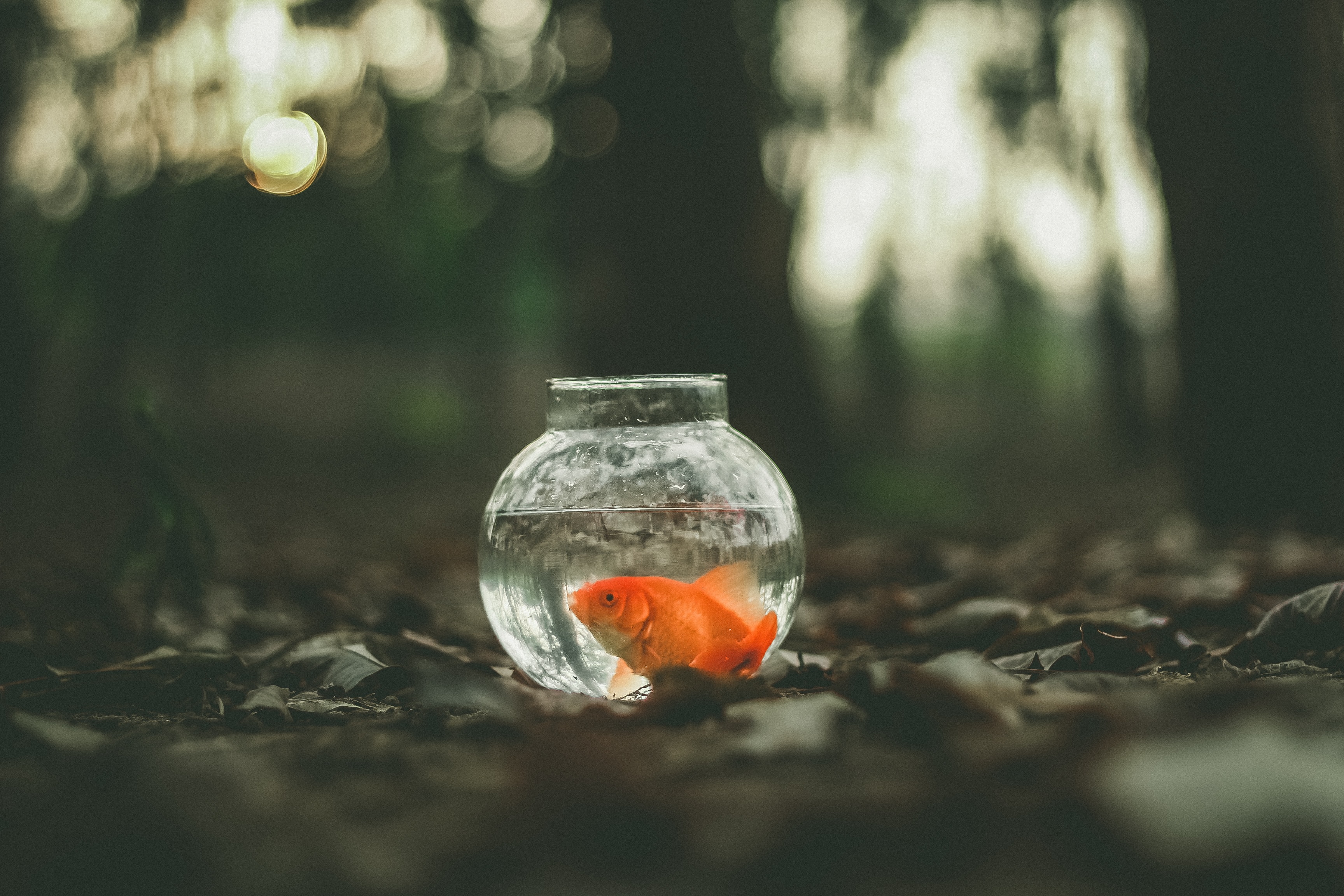
I am merely that fish in the bowl, observing, surrounded by an alien wilderness that I’m somehow connected to.
.
As I was about to finish work, I thought I’d go to Subway to eat lunch. I couldn’t get the image of a double-tomato sub out of my mind. My wife was off in another part of the state so I could choose to eat anywhere. Just to stay in practice, I pretended to have the “I don’t care where we go to eat” argument with myself.
I left work and automatically drove toward Springdale instead of choosing one of the 946 places in Fayetteville. The traffic in Springdale got the better of me. One driver, in particular, seemed to be using a random speed generator to determine her speed. I was fantasizing about participating in an impromptu demolition derby and missed my turn for Subway. Naturally, I ended up at one of the breakfast diners which are coming back in popularity, a place I never choose.
Since I’ve put back on some weight, it didn’t trigger any warning bells as it should have. Let’s be honest, as comforting as the food at these places might be, there should be a heart on the sign by the highway. With an arrow through it.
I parked and as I entered, I waved at a large elderly man sitting on the bench near the main entrance. He was still there, immobile, when I left.
I sat at the counter until my ‘salesperson’ asked what I might like. (They aren’t waitstaff at this diner.) As I started to answer, she mentioned their special peach waffles. I never eat waffles, so of course, I ordered it. As for the rest, I told her to surprise me. She surprised me by bringing a plate-sized but thin waffle covered in peach syrup, eggs, hashbrowns, four pieces of toast, and two pieces of sausage. In the background, I could clearly hear the high-pitched mechanical scream of a bathroom scale. To balance it out, I chose the preferred drink of people who are fooling themselves: Diet Coke.
It was strange to eat at the counter of the diner in part because the entire end of the diner was filled with Latinos animatedly talking. Being a long-time citizen of Springdale, such a detail is not something that passes without me noticing. I tried not to eavesdrop – but I will say that they didn’t consider that I could understand what they were saying. I could write an entire season of “Desperate Housewives” from their conversations. Also, if your name is Pedro and you live near the Supercenter, you should leave town for a few days. (One of those women I overheard is probably going to eviscerate you Friday night after you get off work.)
When the salesperson asked me about the peach waffles, I logically concluded that the peach waffles would be adorned with sliced peaches. Instead, my waffle was slathered with an engine oil-like syrup that somehow simultaneously was sweeter than an entire bag of pure cane sugar and made me think of an insulin syringe inserted directly into my eyeball. I tried to calculate the total caloric value of the lunch I’d been served but the online tracker kept crashing due to insufficient digits available.
Despite knowing better, I ate most of my lunch. A feeling I can only describe as a malaise came over me, one characterized by an inability to think clearly. I recognized it immediately because for the shortest of moments I had the urge to watch Fox News. I tipped the salesperson/waitress exorbitantly in hopes that she might use a bit of the money to eat somewhere else when she finished working.
I waved ‘bye’ to the old man seated on the bench. Much to my surprise, a cardiologist didn’t jump from the bushes and tackle me.
Life is a series of choices. I learned again that I should ignore my instincts – and any buildings with an excessive quantity of yellow paint on the outside.
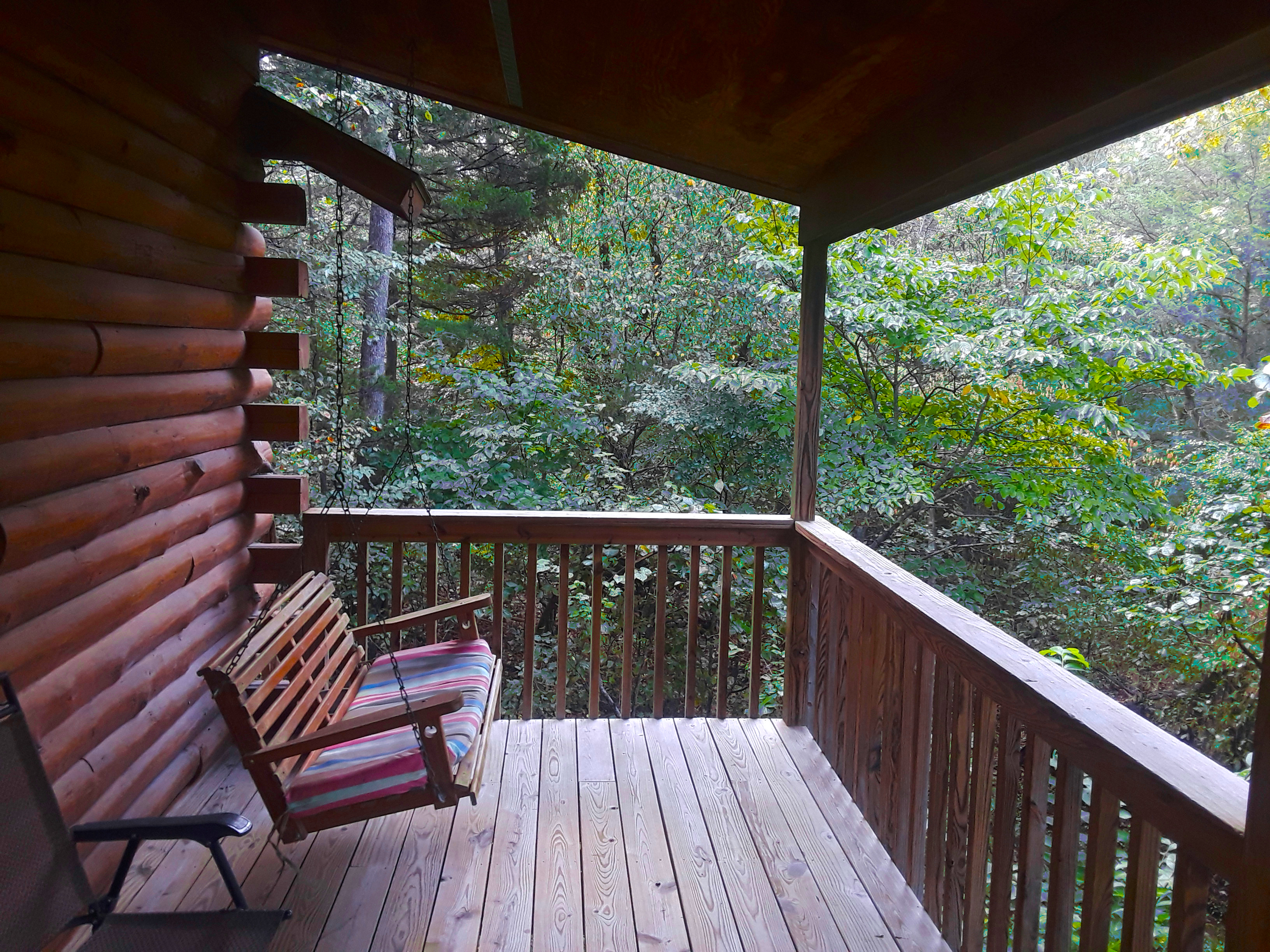
This is the porch on Cabin #3. The porch and its swing is one of the best features that many other places surprisingly fail to include.
Last weekend, we had a chance to get away for the weekend to Wisteria Lane Lodging. At the last minute, we decided to extend the weekend by a day, if possible. The owner at Wisteria Lane gave us the green light. Instead of 2 nights and three days, we stayed for three nights. We stopped at the grocery store and loaded up on food for four days. The difference the extra day made was immeasurable. Vacationing in far-flung destinations has its appeal, I’ll admit, but knowing that we can drive less than forty-five minutes to be in the middle of nowhere with no one to intrude is difficult to surpass.
No cellphone, no internet, no outside world was imposing upon us. Unlike many of the competitor’s cabins, it’s possible to go and see no one during the entire stay. The cabins have satellite television; the solitude is best experienced without the world’s intrusion, in my opinion. I took a laptop loaded with shows and music, along with cables to use the flat screen television to project them.
Dawn and I don’t leave the valley unless we must. Many people who know me superficially are surprised that such isolation is enjoyable to me. Going without wifi and cellphones probably scares those who haven’t experienced it in the last few years. The disconnection is a welcome privilege. It’s a great way to measure your addiction to connectedness.
For those who love to walk or ride mountain bikes, the area is ideal. It’s possible to encounter no cars during your ride or hike on the maintained dirt rods.
While it only rained a bit during our stay, we sat on the hanging porch swing and listened to the thunder of the insects around us as the sun sank below the upper rim of the valley’s treeline.
Wisteria Lane is located North of Eureka and Holiday Island, in a deep valley populated with five billion trees. Cabin #3 & #4 are the best, in my opinion, given their location toward the inside of the forest. Each cabin has a long, covered porch facing the creek running through the valley. Each porch has a gas grill, which allows guests to cook in any weather, either using the grill or the full kitchen inside.
After our trip, I noticed that I hadn’t been billed for the extra night. The owner told me that she was treating Dawn and me to the extra night at no charge. A great trip made more exceptional due to the generosity of the owners.
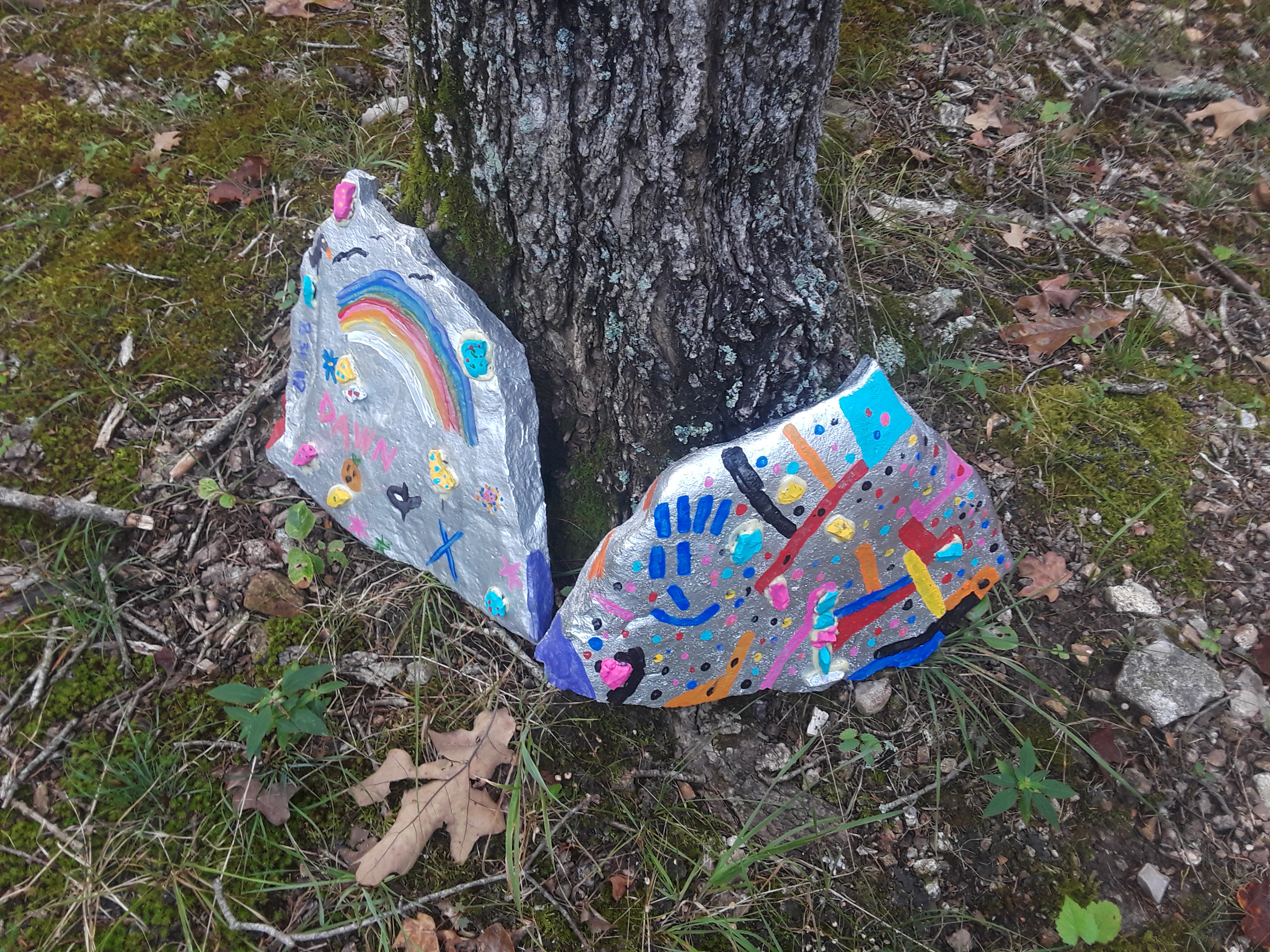
We usually take the time to paint rocks during our stays. We tend to go a little further than most guests.
“Too much time on your hands” is criticism from those who believe their own choices are superior to those being criticized. A lot of our modern lives can technically be identified as a little bit stupid. It’s possible we’re all drinking the Kool-Aid in pursuit of our own hobbies and interests.
From my vantage point, all of of us are bit actors, engaged in our dramas of needless stupidity. I admit my own hypocrisy as I judge what people choose to do with their time, even as you might catch me alphabetizing my pasta collection or writing poetry in imaginary languages. I recognize my dedication to oddities.
“Time you enjoy wasting is not wasted time” is a cliché for a reason.
“What a waste.”
“That’s pointless.”
Watch sitcoms or dramas? “Do” your hair? Play sports? Watch sports? Read fiction? Complain? Nap? Watch movies about killer clowns? Go to movies? Cook complicated dishes with ridiculously-named ingredients? Iron clothes? Dust? Wash car? Shop for clothes? Have pets? Hunt outside? Hunt inside? Like puzzles and crosswords? Paint your fingernails?
TMTOYH people forget that all of us do illogical, stupid, or wasteful things. All of us, especially those of us who vote. Claiming that other people have too much time on their hands falls neatly into the same hypocritical category of criticism; it serves no one.
I suggest that the “too-much-time-on-your-hands” folks have got too much time on their hands, not enough glue between their lips, and a failure to appreciate how much of their own time they spend doing ridiculous things themselves – such as criticizing other people for their choices.
To all those watching, your choices look a little ridiculous. As do mine. If I want to put on over-sized clown shoes and dance like I’ve succumbed to explosive diarrhea for a new Youtube channel, so be it.
P.S. It’s exactly as bad as the old farts who mock the younger generation for watching other people play video games, yet also spend a considerable chunk of their own lives watching other grown me in tight pants play sports. And often on television. Moreover, they pay to watch, too. Jeesh.
An acquaintance of mine reached out to ask me to take a jab at people who are hypocritical about his decision to spend money on fireworks. I’ll call him Slartivaniskivich for this post; mostly because you can’t pronounce his name that way and drop it in casual conversation. Slartivaniskivich felt he couldn’t do the subject justice. Me neither. But I can do it an injustice. There’s no point in being able to capably explain one’s opinion when modern news and entertainment clearly proves that incapably expressing oneself draws more eyes and ears. Being murdered by words never hurt anyone, and all the screaming basically counts as exercise anyway.
Are fireworks stupid? Of course. Is spending money on them totally discretionary, nonessential, and probably a demonstration of craven immaturity? You bet your ass! As long as there’s NASCAR, lite beer, and wine coolers, people are going to spend their money on blowing things up. Or, themselves, depending on quickly they can jump out of the way of danger. For Youtube’s sake, I hope we can reach a delicate balance between horrific stupidity and amusing stupidity.
Dear Karen and John: is the $200 you’re spending every six weeks on your hair, hair coloring, and eyebrows winning you any awards? Is that $110 blouse, the one with fluted sleeves and a tapered waist, worth it? Do you pay for someone to rid your yard, the one you’re seldom in and maintain mostly because you’re supposed to, of weeds? What about those golf clubs, fishing reels, and guns? How about those pyramid-scheme ‘nutrition drinks,’ the ones which cost an unknown amount of money per month? Or energy drinks? Are the cigars you smoke given to you at no charge? Are you washing your car every week in the automated lane? Are you having someone detail your car once a month? Are you subscribing to a meal delivery plan? Have those extra cable packages? Hulu? Netfilx? Eating out for lunch five times a week – and supper 3 or 4 more times? Your daily double latte? Your purchase of lottery tickets? Bottled water? Prepared foods? Do you have credit cards and pay interest on them? Pay for your checking account? Do you smoke? Do you drink? Do you were cologne or perfume? Do you go to yard sales? Do you have storage units? Do you have clothes or shoes you never wear? Manicures? Pedicures? Pediasure? (Ha!) Do you buy your pets special ice cream? Buy brand name products without question? Does your shampoo cost more than $4 a bottle? Do you have needlessly complex cellphones filled with paid apps? How about your subscription music services? Or those custom floor mats, vanity plates, or wheels on your vehicle? Do you own a golf cart, ATV, or motorcycle? Is your house bigger than 1200 square feet? Take vacations or do getaways, whether it’s to the beach, Mexico, Branson, or some other vomit-fueled amusement park? Do you have a favorite sports jersey? Do you collect things of any kind? Does your furniture ‘have to’ match? Do you have special utensils or dinnerware for special occasions? Do you own leather or fur jackets? Do you dry clean clothing?
Obviously, the point is that almost everyone wastes a LOT of money on stupid foolishness. Often, it’s spent for enjoyment and as a means to distract yourself from the ordinariness of daily living.
How you waste your money is your choice. How other people waste their money is their choice. It’s strange that you don’t feel a slap upside your head as you mouth criticism toward people who wasted their money on fireworks. You’re probably wearing $50 sunglasses as you mouth off – or wearing a pair of expensive shoes, even as the other 45 pair in your closet gather dust.
By way of example, a popular cliché sometimes exhorts us to spend our money and time on experiences rather than things. While fireworks are indeed ‘things,’ they also provide the experience of sharing the visual explosions with family and friends. They give a chance to upload videos of the displays that literally no one ever watches. They also give us a laugh if someone blows a finger off. Fireworks are social, even if some of the people involuntarily involved in their use aren’t keen on the experience. Additionally, fireworks give doctors the opportunity to practice their craft with stitches, scalpels, and surgeries, and firefighters the chance to put out roof fires all across these beautiful United States.
Invalidating another person’s stupid choices doesn’t enhance your enjoyment of your foolish choices. Okay, that’s not true. Mocking the choices of others can be fun, even if we don’t like to admit it. I’m saying that based on the 50+ years of observing people as they observe others.
From where I’m sitting, we’re all guilty of wasting our money on some seriously stupid things.
I’d write a bit more, but I need to go buy a polishing cloth for my silverware.
If your sibling, parent, friend, or neighbor wants to waste his money on fireworks, substitute any of the things you waste your money on.
There’s your post, Slartivaniskivich. Now you can link to it once the inevitable and repetitive arguments arise about how you choose to spend your money.
The series finale of Poldark ends, as Ross turns away from Demelza and boards the ship to France, to spy for the British… “I will return,” he says, his devilish grin belying nothing.
It’s likely he will return, albeit years older, in the inevitable sequel which will pass to the next generation of Poldarks, assuming both he and his friend Dr. Enys survive their foray into French espionage.
In the finale, George sees the ghost of Elizabeth once last time. Her back was turned as she entered Trenwith, even as George departed his adopted home, perhaps forever. For me, this was the nod to the sentiment of the series. It’s inescapable that some of the show is indeed soap opera-ish. Almost 90% of all the plot twists could have been avoided if people simply communicated directly. On the other hand, this sort of logical human discourse would make good drama impossible.
The actor who played Poldark in the original version of the series in the 70s made several appearances in this series. Poldark’s horse Seamus has its own Twitter account. (Yes, really.) If you want to visit Trenwith, it’s Chavenage House, in Beverston, Gloucestershire. If you were confused by the layout of the surrounding mines, villages, and towns, don’t be: in reality, they are not proximate. (And Poldark didn’t travel everywhere via the coastline and cliffs, as the series would have you imagine.)
Like Elizabeth’s ghostly return, the rebirth of another Poldark storyline is inevitable. Everything rests on the shoulders of the writers who can imagine the full world that Poldark brought to us.
The series finale is a call to remember that the principal characters will carry on, even if in our imaginations.
All of our stories must end in a predetermined conclusion. Drama, laughter, and finality.
May this serve as a tentative ‘goodbye’ to the series. I will miss the show, but certainly not the hat.
I am certain that another line of Poldarks will live to remind us what we found so sublime and delightful in this series. I’m predicting that they’ll find another unnaturally good-looking actor to serve as the focus of the revival. Don’t bother calling me, BBC One. I’m busy.
.