
I wonder who came up with the phrase “let’s crime.” As its core, it is pure genius, despite being lazy by using a noun as a verb. I give it my endorsement, though.
Stay fresh, cheesebags!

I wonder who came up with the phrase “let’s crime.” As its core, it is pure genius, despite being lazy by using a noun as a verb. I give it my endorsement, though.
Stay fresh, cheesebags!

*Note: this post might make you uncomfortable.
A recent viral video of a black man giving a speech regarding gun rights at a city council meeting struck me as odd. In the video, he passionately discusses what the founding fathers meant when they wrote the constitution. His speech was shared countless times.
This post isn’t about gun rights at all. It’s about the underlying history of our country, one which was based on denial of rights to large segments of society.
If you get distracted by the mere mention of a gun, you’re missing the entire point.
I can’t get over the fact that the constitution and many who wrote it didn’t see the speaker in question as a person at all, much less one with the right to address a political body, own property, vote, or own a firearm of any kind.
I feel uneasy about the gentleman’s reasoning and my surprise at the arguments he used. He used his status as a law-abiding citizen as a foundation for his speech. This, too, presents problems, as being law-abiding has at times in our past required us to honor the right of some to own other human beings, segregate schools, force citizens into concentration camps, deport American citizens, and to sit idly as many in our population were treated as lesser human beings. “Law-abiding” is such an intolerably low threshold for us. The law serves as a framework for us, but it has also allowed all manner of atrocious conduct among citizens.
I dislike arguments appealing to the intent of the founding fathers. That all of them were men is itself part of the problem. Wealthy men of privilege, no less. Their intent isn’t relevant to our modern right to governance, although it still mostly resembles our modern government. We have the right to amend or deviate from any and all intentions of the rich men who wrote the constitution, without deference or adoration.
If we are not responsible for the sins or omissions of our ancestors, neither are we accountable to their norms and failures. We are free to draw on this map of ours in any matter we see fit.
I don’t revere documents, especially ones which codify ideas which contradict much of what we now esteem. Instead, I observe the arc of history and wonder what we might choose for ourselves if we weren’t saddled with the tired arguments of the ghosts who preceded us. More importantly, how might we choose if reason itself were truly the ideal we cherished above all others?
It’s a scary thought for many to consider that our constitution was built with the concept of amendment. We can choose to change course, even as many fight all attempts toward progress. We can’t make America great again until we’ve managed to live a century without engaging in barbaric behavior. It’s dishonest to claim that we’ve done so.
It’s precisely that reason that the black speaker in question was able to address his representatives, own firearms, and be a full citizen. Without the process of change and amendment, such expression would not have been possible. There are wide swaths of our modern United States in which I am certain that the speaker in question would not have been welcome to speak publicly.
The speaker in question demanded his constitutional right to bear arms, all the while failing to see the quicksand of incongruity on which his argument rested. The founding fathers did not believe that the constitution applied to him. Even as the speaker used the constitution to demand his right to freely own firearms, he missed the contradiction that the same document originally prohibited him from being included among those with such rights.
One change granted him citizenship; another might overtake him.
And so, we march forward, uneasily wondering what change will greet us.
Some of us want more, for all.
Others, the same, as before.
.

It is impossible to say this without sounding snarky or motivated by lesser intentions. If you continue reading this, you’re going to have to accept that I’m not coming from a place of distrust or anger: I’m just perplexed. Unlike most social media, I only share what I own. Nothing is more ‘me’ than the words I take the time to share.
Some people will read this and become angry or defensive. That reaction should serve as an indicator of how dissonant the issue can be. If you are convinced I’m wrong, you will do yourself a disservice by either lashing out in anger or attempting to craft an argument to convince me otherwise.
I’m just one man sharing my opinion. It’s mine, based on years of reading, observation, and insight.
Anyone with sufficiently confident ideas couldn’t possibly be rendered floorless by my wild ramblings. Truth should never avoid the footsteps of inquiry.
The longer I’m alive, the more perplexed and confused I become in observance of the obedience and participation women have toward doctrine or churches which continue to discriminate.
For all those giving up something for an observed religious holiday, I would ask you to instead consider giving up any religious organization which prohibits women from having an equal footing from top to bottom of the organization.
I’m not asking you to give up your understanding or relationship with your creator or your religion. I’m asking that you instead pledge allegiance to an organization which doesn’t openly take you task for having been born the opposite sex.
Don’t be fooled by mission statements honoring your “alternate role” or anything other than full participation.
Less is lesser, no matter how gilded or prophetic the language used to disguise it.
It’s not a slippery slope; it’s a sharp cliff.
It’s hard to imagine being 52% of the population, yet accepting membership in a church which refuses to stop discriminating.
For men reading this, it’s important that I’m clear: you are wrong if you persist in your insistence that religion demands that women accept lesser spiritual roles. Religious texts have been used to justify all manner of behavior and norms that we now find to be ridiculous. Clinging to tradition or the expository religious texts of your church does not compel intelligent agreement. It’s time. I’ve yet to hear a convincing argument from a man regarding why a woman can’t be a leader in his church. I’ve certainly heard some angry arguments – and often at high volume.
Condemning me to hell only serves to demonstrate how so many fail to see that we only truly preach by how we live. I never learn from an angry voice or a snarled lip and I suspect that no one else does, either.
Each of us must make our own choices for our own reasons. I know that it’s complicated.
But it doesn’t have to be.
I have great difficulty trying to come to terms with the idea of some of the strong women I know who tolerate organizations which do not honor their right to be equals at the table. Some say they’ve found great peace in their respective churches. I find it difficult to imagine that they’ve done so without great stirrings of distrust as they witness being excluded.
These same women, going about their regular lives, would be outraged at the institutionalized discrimination found in their own churches if it were to infect their daily lives.
If your church tells you that cannot be a pastor, priest, or equal to any man in the organization, it deserves to be replaced by another, one without such ideology.
There are a great number of churches which recognize women as equals in all matters spiritual. Are we to believe that their doctrine is wrong? And if they are wrong, you must accept that for some peculiar reason, women are not a man’s equal where religion is concerned. Most of us see it and recognize that it’s wrong. We just don’t know how to get from ‘here’ to ‘there.’
Logistics aside, if even half of all the women in gender-restricted religions and churches stop tolerating it, these churches would wither almost immediately. There are few such social systems in which the fix is both glaringly obvious and available.
Just stop.
Take your intelligence, your presence, your love, and your compassion and let it grace the door of a church which honors women as equals. Let your sons and daughters know that God is an insufficient excuse to continue to practice spiritual discrimination.
It might burn to hear it, but many of us are waiting for the other shoe to drop and for women to stand up and demand this change. It would happen immediately if every woman currently attending a church which does not recognize women as total equals stopped attending, stopped donating, stopped participating, stopped honoring, and stopped accepting being told “no.”
You might be surprised to know that many men already share your distaste with gender-spirituality. And for those that don’t, you can’t change their minds by waiting for them to come around to sensibility. It’s time for a slammed door or a proverbial skillet to the head.
It is true that you absolutely can find your own way inside such discriminatory organizations. I see that it’s a problem for a man to be pointing toward discrimination. It’s also true, though, that if you decide that it is unacceptable and shout your objections and immediately detach, church leaders will have no choice but to admit they’ve been derelict for a few thousand years.
No matter how old a church is, if 52% of the congregation shouts “NO more!” you can be sure that change will come immediately or that reluctance will clearly signal something fundamental is at work.
Whether your church intends to marginalize women by disallowing them full participation, the result is the same: your voice is among the lesser. You are not a full participant. You are condoning the perpetuation of the system which has identified you by gender as unequal.
Allegiance to such churches based on tradition dishonors our ability to determine our own course.
If you truly love your church, demand change.
If you truly love yourself, be open to the possibility.
Not at some imagined future point; rather, today. It will only sustain itself if it embraces this change. If it does not embrace it, it will eventually wither anyway.
X
.
.
.
I stopped to ask him what he was doing or perhaps to help. He was struggling to get a heavy mechanical device onto the ground. “What are you doing?” I asked him.
“Well, the light on the dashboard said ‘Place Transmission In Park.'”
.
.

Technology can be offensive. My bank uses facial recognition software in real-time using ultra-HD cameras. As I opened the vestibule door to enter the bank, a computerized voice said, “Sir. No animals are permitted in this facility.”
.
.

“I feel like a snack” versus “I feel like having a snack.”
Also, I’m never taking one of Dawn’s “shortcuts” again.
.
.
My doctor is old school but the leeches were a bit much.
.
.
I attended a rally and got excited when the speaker pointed at me. “You can make change!” he shouted. And then the rolls of quarters, pennies, and nickels hit me. I wasn’t ready for change.
.
.
I stopped to ask him what he was doing or perhaps to help. He was struggling to get a heavy mechanical device onto the ground. “What are you doing?” I asked him.
“Well, the light on the dashboard said ‘Place Transmission In Park.'”
.
.
Not to be lost in the shuffle, every second is an occasion unto itself.
.
.
The door greeter/attendant came toward me with a cart. He pushed it my direction.
I quickly said, “Can you help me get in it?”
Before he even really listened, he said, “Yes sir.”
As soon as he said it, he turned a little red.
.
.
Saturday, I hit the gas instead of the brakes – and drove through the front window of a vintage record store. The Guinness Book of World Records called and told me that I now have the record for most broken records.
.
.

As Connie soon learned, skydiving is one of those hobbies in which one should n-e-v-e-r choose the super-savings package.
.
.
Wishing to know the meaning of “forever,” I went and waited for my wife in the car.
.
.
“Play games & have fun here at work,” management instructed. That came to an end today, though, when I noticed a pair of idiots in the meeting and yelled “YAHTZEE” to everyone.
.
.
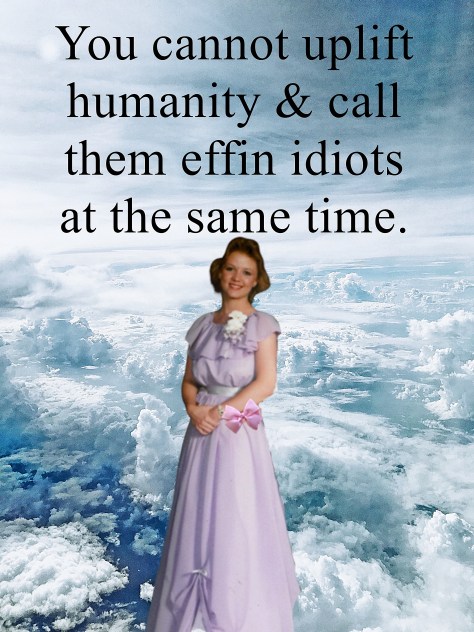
(Made with a friend’s high school prom picture, just for good measure.)
.
.

Re-purposing safety posters – and using coworkers pictures to do it.
.
.

Is this a “I want to speak to a manager” haircut?
.
.

At a local supercenter, they’ve had an on-demand Rubi coffee kiosk installed near the deli for most of the newer store’s existence. I’ve decided that its presence is, in fact, a complex social experiment to test us, much like the infamous “fat-free but great taste” all of us morons routinely fall for when we buy new foods, only to curse our ongoing stupidity.
Despite the coffee kiosk being installed for almost all the store’s history, I’ve never successfully managed to elicit a cup of coffee from it. My theory is that no one has – ever.
Today, in an incident which substantiates that I do have a sense of optimism left in my old bones, I approached the machine with suspicious eyes. This kiosk is an old enemy of mine, one whose promise of delicious coffee remains unfulfilled. I fed a dollar bill into its sophisticated electronic payment receptacle. From there, I continued to select options. I noted that a strange feeling of “This time it’s going to work” grew in the pit of my stomach. I watched in wonder as the successive notifications built to a stunning notification: “Your delicious cup of coffee is brewing.” I could literally smell it doing something with some unseen exotic coffee beans hidden in the guts of the machine. Yes, my mouth watered, and I’m ashamed to admit my optimism.
Then, without fanfare, the machine said, “Enjoy!” and then “Thank you!” The coffee cup, carefully positioned under the brew spout, sat empty. I swear I heard a scream of maniacal laughter from inside the machine as I made a face comparable to a four-year-old as he tried broccoli for the first time. I quickly looked around to see if someone nearby might be recording me for his or her own amusement. “Local Moron Falls For Coffee Kiosk. Again” would be the headline on the HuffPost story.
As most of you know, I routinely carry a stack of note cards in my back pocket. I took out my marker and wrote “Out of Order” on several cards and stuck those cards in every surface with a place to squeeze a card inside it. I wanted to write something a bit more curse-worthy, though.
I walked away to resume piling unneeded items into my wife’s shopping cart. Because I had been defeated yet again by the Rubi coffee kiosk and couldn’t shake the feeling of stupidity, I returned to the scene of my bitterness and corralled an employee from the deli area.
“Oh, my manager won’t leave the Out of Order signs on the machines because they are hand-written,” she told me when I asked her why the machine wasn’t marked. “Yeah, it’s been out of order again since at least yesterday. A bunch of people has complained. I bet hundreds of people have had their money taken by this machine since they installed it.” She laughed. She told me I could go to Customer Service if I wanted to be ignored by a different set of Walmart employees.
“We’re not happy until you’re not happy,” I told her. “Is that still their motto?”
I showed her the cards I had placed all over the machine. She was impressed that I carried cards in my pocket.
“So the manager would rather customers get defrauded than see a hand-written note on the machine?” I asked, just to be certain I had a clear grasp of the managerial stupidity obviously at work.
“Yes, it’s like Dilbert minus the entertaining punchline around here all day.”
I laughed. “Tell the manager that if he or she takes my cards off this machine, I am going to get my lost dollar back in the most creative way possible.” As I said this, I placed another card on the machine, one on which I had written, “Shop at Target.”
“Nice!” the clerk said and laughed again.
Currently, the Rubi coffee machine is at least 4-0 where I’m concerned.
Fairly or not, I’ve decided that the Rubi coffee company’s brand of coffee undoubtedly must take like boiled rat doodoo. It’s the only logical justification for NEVER having dispensed me a cup of coffee on any of my attempts.
I’d like to thank the unnamed manager, the one who thinks it’s better to knowingly leave a broken machine unmarked than to simply put a sign on it. It sounds like Walmart logic, of that I’m certain.
I’ll keep trying, though. The next time the machine wins, though, I’m going to have 500 notecards in my pocket, and each of which will be autographed and personalized in a such a way that everyone will be scandalized.

The simplest truths are the ones most often wrapped in amber. Distant memories, familiar, and unreachable.
Commentary Comment Criticism
A common refrain is “Don’t read the comments on news sites.” But not for the reasons you’d expect – but because so many obvious non-readers leave comments there.

As an acclaimed problem ̶c̶a̶u̶s̶e̶r̶ solver, I finally made an official template for reasonable choices in regard to the herpetic toilet paper roll quandary. Its ongoing existence is proof that the adage, “Everything. Everyone. Everywhere ends, except an argument,” is true.
It’s more pernicious on social media than a case of goat rash. I think Robert Mueller is about to indict all of us for perpetuating it.
I don’t care how you want the roll, nor does anything the patent holder for it might have to say interest me. Let’s be honest, there’s no way we’re all going to agree on the orientation of the toilet paper as it hangs from the holder. We can’t even agree on who is the best presidential candidate to ruin our country.
In the past, I’ve simply pointed out that the roller is not required for household use under federal law. Neither is toilet paper, for that matter, but it makes any food ‘hand-made’ sound terrible. You can put the roll any direction you want, or anywhere you want to put it. Don’t take that TOO literally.
As Neo might have said, “There is no hole and no roll, either.” Interpret as needed.
I can’t go a day without seeing a protracted argument about toilet paper rolls.
(Not to be confused with my recipe for delicious Toilet Paper Rolls & Croissants, which are scrumptious.)
The idea that, as an adult, you can simply choose NOT to use a toilet paper holder (like a savage or Alabama resident) surprises people. If you aren’t allowed to ‘free roll’ it, you should feel free to use any of the horrible guest hand towels in the restroom in lieu of paper in the loo. And flush those, too, just to keep the plumber economy robust.
I hereby grant you the right to simply not put the toilet paper roll on the holder. After years of testing, I’ve determined that it will not contribute to the apocalypse.
Likewise, if you’re are feeling really mean, put two holders in the bathroom. Hang one as “A” and the other as “B.” Fill the bathtub with loose rolls, too, just to cover your bases. It is possible that one of your guests might have eaten at Domino’s pizza and in that scenario, 123 rolls of toilet paper might be just enough.
You’re welcome.
Or ‘your welcome,’ if you are into random grammatical errors.
“How’s it hanging?” will no longer be a casual question we need to concern ourselves with.
.

A couple of years ago, I made a picture for another website. Since it was my picture, I posted it on my own social media. A few people got irritated about it. They didn’t directly share their aggression, though. They snarked and bit at the fringes of their frustration. It’s what people do instead of finding a way to honestly share their uncomfortable opinions.
Because so much time has passed, I’ve learned that the irritation resulted from their displeasure with the word “privilege.” It’s one of those words which people have sometimes weaponized to imply that well-to-do people have become blind to the real world or minority considerations. On the other website, the one which didn’t attribute the photo to a person, the commentary turned dark and sour very quickly. The word has only become more amplified and vilified since then. Memes refuting the absurdity of the implied observation of privilege are immensely popular.
Coincidentally enough, a couple of social media friends recently shared anecdotes about their daily lives. They neatly tied conclusions to their stories. The problem is that they were oblivious to the privilege embedded in every aspect of their stories. I only noticed it because their stories generalized stereotypes about the circumstances of the other players involved in their anecdotes, the bit players serving as the backdrop for their conclusions. Having money, time, and means to travel to a place and have someone else prepare their food, serve them, and attend their needs is a part of the privilege of having resources. I, of course, didn’t mention my observations to them. That sort of honesty draws a bit of anger and retaliation. Most people enjoy the satisfaction of thinking that their success is due almost entirely to merit.
Make no mistake, many people have worked hard and made the right choices. I know several people who deserve respect for the way they’ve played their cards.
As we all know, however, it is possible to do everything right and still lose, though.
For some of us, we know that a single moment, one unearned, can ruin our lives, plans, finances, or health. A body on the floor. A negligent motorist at an intersection. An undiagnosed valve in someone’s heart. Cancer cells in one’s lungs, even after never smoking and living a clean life. A plane falling from the sky on a Saturday morning in September. A call to defend one’s country halfway around the world.
Some feel that their faith or belief in God has favored them. Whether this is true or not, I know several devout people whose lives are infused with compassion and lovingkindness who’ve experienced some of life’s most grievous challenges. Whether it makes people uneasy or not, faith does not equate to favorable circumstance upon us, nor is a lack of it a reason for failure. Grief and good are sprinkled in equal measure upon everyone.
It is possible to feel satisfied with one’s full life. Pride, honor, and fulfillment are natural consequences of threading the complex needle of circumstance in life.
Good people don’t weaponize the word “privilege.”
Good people also don’t fight the necessity of recognizing their luck against the prism of reality.
For some, their mantra is “If you don’t have to think about it, it’s privilege.” For others, “If it’s not a problem to you personally, it’s not a problem.” Also, “The fact that privilege helps you doesn’t mean you didn’t have to work hard, but it does mean that others have to work harder to overcome societal disadvantage.”
These quips are popular because they antagonize the simple fact of privilege and turn it into an accusation as if those with privilege all abuse their opportunities selfishly. These simplistic bumper sticker quips exist precisely because some people snarl and bark when asked to recognize their head start in life.
Fair or not, I feel rich. And privileged. It’s foolish for me to look around and forget how lucky I am. Most of my luck is a result of geography, not effort. I’ve been lucky enough to have decent health and at least access to a massive medical infrastructure to rescue me if not. My youth was violent and poor. I had the privilege of miraculously avoiding making one too many mistakes that would’ve derailed me further. I’m proud of my aversion to the politics and prejudices of those around me when I was young.
Simply put, the majority of my life’s privilege results from where I was born on this planet. The rest falls to demographics, education, and opportunity. I can’t take credit for those things.
I don’t have to curse myself for being lucky, either. Nor should any of us feel guilty. But we should all feel thankful.
Absent some of these factors, no amount of pluck and effort would have propelled me above the station I would have otherwise been assigned.
Privilege. The privilege of being.
If you zoom out above the Earth, you’ll find that your life is one of wealth and privilege. Comparison proves that you are lucky to have been born where you are, with the body and mind you have, accompanied by the geography and economics of opportunity.
If you’re accused of ignoring your privilege, lean into and be thankful for your life.
.

“You sound weird.” -A quote from a member of one religion to every other member of any other religion or denomination.
Corollary: “Additionally, while I’m not specifically saying so, your way is misguided.” Also known as “The Highlander Rule of Religion” – as there can be only one.
Corollary Sequel Pertaining to Deniability: Even if you’re not aware of it, almost every religious person looks at the beliefs and practices of others with an aloof, if not a superior, critical, or comedic eye. Including yours.
Bacon? Temple garments? E-meters? Mysticism? Kaparot? Exorcism? Blood transfusions? Self-flagellation? Fasting? Confession? Scripture? Polygamy? Snake handling? Speaking in tongues? Animal sacrifice? Confirmation? Hymns? Silent worship? Reincarnation? Caffeine? Alcohol? Priesthood? Anointing? Penance? Communion/Eucharist/Transubstantiation? Meditation? Sin? Circumcision/Bris? Purification? Genuflecting? Faith healing? Praying? Guru? Karma? Baptism? Rapture? Armageddon? Prophets? Miracles? Crucifixion? Celibacy? Vows of silence? Pilgrimage? Cremation? Burial? Polytheism? Monotheism? Idolatry? Angels? Demons? Heaven? Hell? Purgatory? Sabbath? Original sin? Commandments? Male authority?
This post isn’t anti-religion. Any inspection of religion tends to spark an immediate and wrathful reaction from those who feel accused by outside observation or commentary, even if people are just asking questions. It’s an observation regarding how members of different religions react to how others practice their own distinct faiths. I’ve come to distrust those whose reactions tend to be angry or strident. The only sermon that works in the lives of others is one of example. “Words conceal, actions reveal” tends to be a great way to gauge someone’s convictions. Shouting may result in silence or cooperation but never conversion.
As an outsider, it’s fascinating to observe the huge variety of religions and denominations. Most adherents tend to practice supremacy in regard to their own particular faith and rituals. It’s the human way of doing things. It makes for some dreadful consequences at times, especially to those of other faiths or no faith whatsoever. The insistence of certainty clouds human interaction as thickly as just about any other human condition.
Having lived more than half a century, I still sit in amazement as I observe the faithful from one group interact and observe others as they go about the practice of their faith. One of life’s greatest pleasures is discovering someone with faith who walks their path without regard to the path another person chooses. They often get drowned out, though. The urge to judge the path of another is almost inescapable.
“We all sound crazy to somebody else.”
Except in my case. I sound crazy to everybody else.
.

